Characteristics of Japan's Leather Manufacturing Industry and Tanners
Japanese leather has a 1,500-year history, with many leather processing techniques believed to have been introduced by people arriving from the Continent before the Asuka period. In ancient times, deerskin was most popular, used widely for armor, horse tack, clothing, bedding, and more. Later, cowhide, horsehide, and pigskin also came into use. Today, cowhide is the most widely produced leather in Japan, though hides from pigs, horses, sheep, and deer are also produced. Beyond finishes that maximize each type's inherent qualities, Japanese leather also incorporates traditional techniques like indigo dyeing, lacquer work, and sumi-nuri (ink-flow dyeing), resulting in uniquely Japanese leather finishes.
Even within Japan, the characteristics of the finished leather vary due to climate, culture, and historical background. However, Japanese leather is said to be distinguished by its greater stability in quality, higher reproducibility, and more meticulous finish compared to leather tanned overseas. A key factor in producing this leather is Japan's abundant water sources, essential for the finishing process. Japanese rivers are generally short and fast-flowing, contributing to their clean water quality. Japan's leather-producing regions boast multiple pristine rivers, whose water is used for meticulous tanning processes. Additionally, efforts to address environmental concerns have intensified in recent years, leading to a greater focus on non-chrome leather and eco-leather. Leveraging Japan's technological expertise, new types of leather are continuously produced.
Japanese tanners have a strong reputation for business integrity. They strictly adhere to contracts with clients, delivering meticulous finishes, minimizing waste, and ensuring timely deliveries—all within the often challenging leather production process.
Production Area Introduction
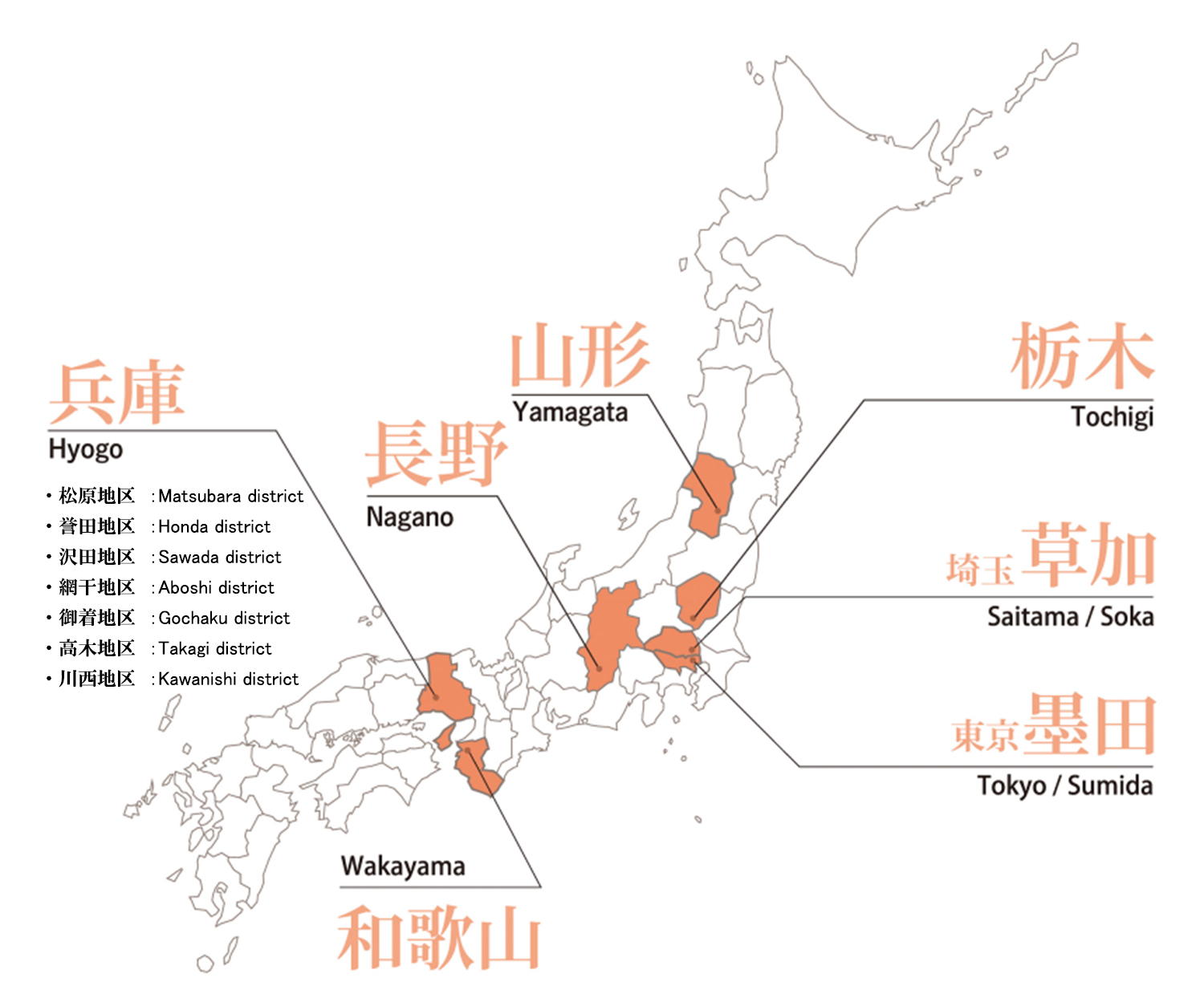
The Himeji and Tatsuno regions of Hyogo Prefecture have the highest production volume in Japan. This region, home to 60% of Japan's tanneries, comprises seven districts: Matsubara, Honda, Sawada, Aboshi/Jihoji, Otsuki/Shigo, Takagi, and Kawanishi. By combining traditional techniques with cutting-edge technological development, the region produces leathers that defy conventional expectations. The region is also dedicated to reviving and preserving traditional tanning techniques, fostering a community-wide approach to leather production that embraces learning from the past to innovate for the future.
Produces a wide range of products including chrome-tanned leather for bags, clothing, gloves, industrial applications, interior design, and chair and car upholstery.
This district specializes in thin, chrome-tanned leather, and produces a wide range of products, including apparel, gloves, handbags, pouches, and footwear.
Specializes in thin, chrome-tanned leather for apparel, gloves, bags, and footwear.
Japan's largest producer of animal glue, gelatin, and collagen products. The region is also known for its chrome-tanned goods and prominent shoe leather production.
This area is known for producing chrome-tanned leather for shoes, bags, and clothing; blue leather for zori sandals; and vegetable-tanned leather.
This district produces a wide range of leathers, including those used for shoe uppers, bags, luggage, and clothing. It also produces horse leather and Himeji white-tanned leather.
This district specializes in thin, chrome-tanned leather for apparel and gloves. It is renowned for its unmatched techniques that produce exceptionally supple leathers ranging in thickness from 0.4 to 0.6 millimeters.
Tanners in Wakayama have mastered the production of specialty items, such as vegetable-tanned leather, split leather, sheepskin leather, and enamel finishes, a signature Wakayama technique. This enables a single company to integrate and manage the production of specialized leathers, which usually requires a division of labor. This creates an environment capable of handling orders that would be difficult for others to accommodate. Furthermore, tanners maintain strong solidarity, enabling the smooth sharing of information and techniques.
The Sumida district of Tokyo is known for producing "Made in Tokyo" pigskin leather, crafted from pure domestic pigskins. The district is not only home to tanneries but is also a hub for leather-related businesses, including wholesalers, shoe and bag manufacturers, and distributors. Additionally, the district has a town-wide production system in which specialized craftsmen and workshops for tanning, dyeing, processing, and skiving are gathered. This division of labor fosters an environment well-suited to handling labor-intensive custom orders.
The leather industry in the Soka area has a shorter history than in other regions. To change this situation, tanners collaborate across the community, handling a diverse range of leathers, from cowhide to exotic skins, and involving in every step of the process, from procuring raw hides to creating finished products. Their constant embrace of new challenges has led to their eco-leather initiatives and the passing of techniques on to the next generation.
There are not many tanneries in the Tochigi, Nagano, and Yamagata regions, but the ones that exist include those large-scale tanneries capable of processing all types of leather, and those specialize in large leather goods, such as sofas and chairs. These tanneries leverage their proximity to abundant water sources and maintain their distinctive characteristics.
Exhibition and Event Overview
| Exhibition/Event Name | Host city | Content | |
|---|---|---|---|
| 1 | LINEA PELLE | Milan, Italy | Held twice a year primarily in Milan, Italy, LINEAPELLE is the world's largest leather trade fair. It attracts over 20,000 apparel and leather goods designers and buyers as well as more than 500 tanneries from around the world. The event is also held in New York and London on alternating months. LINEAPELLE has a co-sponsorship relationship with the Tokyo Leather Fair. |
| 2 | Premiere Vision | Paris, France | Founded in 1973, it is the world's premier fabric and leather trade show. It is held twice a year in February and September, in Paris, France. The trends (colors and textures) proposed by Première Vision are said to significantly influence the fashion industry. |
| 3 | APLF | Hong Kong | APLF is an international leather industry exhibition that connects Asia with the rest of the world. The exhibition serves as an indispensable venue for gathering information and creates important business opportunities for companies seeking suppliers of related finished goods and materials, as well as original equipment manufacturers (OEMs), and OEM contractors. The exhibition also attracts designers and buyers from the fashion industry. |
| 4 | MIPEL | Milan, Italy | Held twice a year in Milan, Italy, this event features renowned brands and emerging manufacturers. Approximately 400 companies exhibit bags and leather goods. Around 15,000 industry professionals from around the world attend the event. The event has also become a gateway for emerging designers and manufacturers. The international footwear trade fair “MICAM” is also held concurrently. |
| 5 | COTERIE | New York, USA | Similar to MAGIC, one of the largest apparel trade shows, the event is organized by UBM as part of the NY Women's September exhibition. The NY Women's September consists of eight shows, one of which focuses primarily on women's fashion, shoes, and accessories. |
Major Leather-Related Certification Systems
| Certification system | Certification Bodies | Content | |
|---|---|---|---|
| 1 | JLP (JAPAN LEATHER PRIDE)tag | Tanners’ Council of Japan | The “JLP Tag” certifies that the leather is natural and was produced in Japan. The tag aims to provide consumers with peace of mind when using leather products. The tag operates under an application and approval system based on specific rules. Only Japanese tanneries that perform retanning, dyeing, and fatliquoring in-house from raw hides and wet blue, and properly treat wastewater, are permitted to use the tag. The tag may only be affixed to leather goods manufactured in Japan with at least 60% of the surface area is the leather that underwent these processes. |
| 2 | Leather Working Group (LWG) certification | LWG(LEATHER WORKING GROUP) | The LWG's objective is to encourage leather manufacturing facilities to adopt sustainable and environmentally responsible business practices, with the expectation that they will protect and maintain the environment. The LWG establishes environmental priorities and achievable standards in its guidelines, enabling continuous improvement. Headquartered in the UK, the LWG is an international organization that promotes awareness of leather quality, safety, and environmental issues. Currently, most globally renowned brands are members. In recent years, the number of tanneries and brands joining the LWG has increased rapidly, establishing it as a mainstream global initiative. |
| 3 | Japan Eco Leather (JEL) Certification | JAPAN LEATHER AND LEATHERGOODS INDUSTRIES ASSOCIATION | The Japan Eco-Leather Standard (JES) established in 2006, is a collaboration between the Japanese Association of Leather Technology, which is an incorporated nonprofit organization, and the Japan Tanners Association. Eco-leather refers to leather materials that comply with the “Japan Eco-Leather Standard (JES)” and are recognized as having a low environmental impact throughout the entire product lifecycle, including manufacturing, transportation, sales and reuse. JES label certification is limited to “leather that does not damage the cross-sectional fiber structure of the skin,” and the fundamental requirement is that the leather remain functional during reuse. |